Find out how 3D printer quickly replaces industries through prototypes, individual products and durable production.
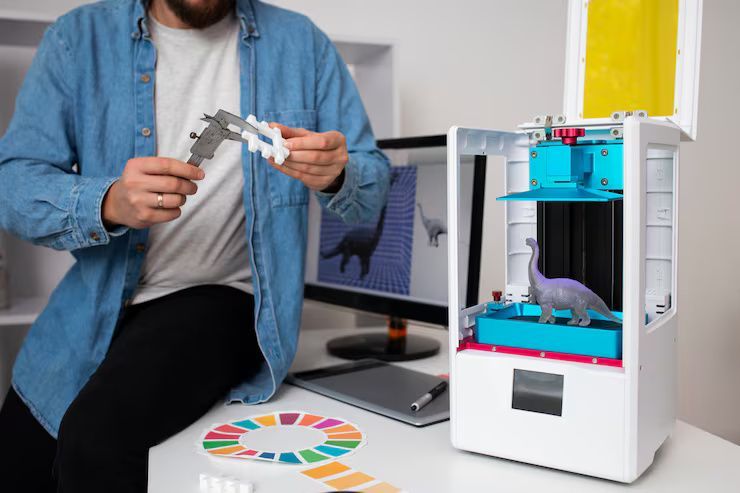
3D printers are devices that form three-dimensional objects from digital files by adding the content layer after the layer — a process called an adorable production. When limited to industrial surroundings, today's 3D printers are now available for hobbies, designers, engineers and teachers.
From print equipment and furniture to dental transplant and home, 3D printing is again for how products are designed, manufactured and distributed globally.
The Benefits of 3D Printing Technology
-
Quick prototyping
Engineers and designers can test product design within hours. -
Adjustment
Products can specifically be done for individuals (e.g., prosthetics or fashion). -
Reduced additives production
In contrast to traditional subtraction methods, only the necessary material uses. -
Low production cost
Especially too little volume or special items. -
Production on request
Eliminates the requirement for major inventions or foreign supply chains.
Types of 3D Printing Technologies
-
Fusted Provision Modeling (FDM)
-
Melts and plastic filaments exclude layer-by-layer.
-
The most common and cheapest technology.
-
-
Sterolitography (SLA)
-
The liquid uses UV light to fix the resin.
-
High resolution, ideal for smooth surfaces.
-
-
Selective Laser Sintring (SLS)
-
FUS powder material using a laser.
-
Strong and durable parts are often used in aerospace and car.
-
-
Digital lighting
-
Similar to SLA, but fast.
-
Ideal for applications for dental and jewelry.
-
-
Multi Jet Fusion (MJF)
-
HPS proprietary technology for high-speed industrial printing.
-
Strong, functional part with good finish.
-
Selecting the Right 3D Printer
What to consider here:
-
Objective: Prototype versus end products versus use
-
Material compatibility: PLA, ABS, resin, nylon, metal, etc.
-
Print Volume: The size of the goods you plan to print
-
Resolution: Nice description or fast drafts?
-
Ease of use: Early friendly user interface, setup and maintenance
-
Software: Compatibility with CAD tool or slice software
Future Trends within 3D Printing (2025 and Beyond)
-
Bioprinting of organs and tissues
3D printers are used to repeat live tissue structures. -
Continuous filaments
Biodegradable materials and recycled lining with plastic. -
Distributed production
The products are printed locally and reduce transport emissions. -
AI-FAINED DESIGN ATMATION
Generic design using machine learning for optimal efficiency. -
Multi-content and full-color printing
Complex prototype produced with different properties in one race.
Tips for Successful 3D Printing
-
Use a hot bed to prevent war (especially with ABS).
-
Leave the print bed regularly for quality results.
-
Save filaments under dry conditions to prevent moisture problems.
-
Calibrates the writing settings before each main project.
-
Always clean the print nozzle and the step between the jobs.
General Questions about 3D Printer
Q1. Is 3D printing legal?
Yes, although printing of limited objects (e.g., arms) in most countries is regulated by the law.
Q2. Can 3D printer print metal?
Yes. Specific industrial printers use powder-based or filament-based metal printing.
Q3. Is 3D printing environmentally friendly?
It uses little material and enables local production, reduces emissions and waste — especially when biodegradable filaments are used.
Q4. What type of 3D printers use?
.STL and .OBJ files are the most common. The design is done in CAD software, and is then converted using the Slice software.
Summary: Strength Building with Accuracy
3D printers have gone beyond prototypes to revolutionize industries from medicines to production. With the progress of the material, the AI integration and decentralized production, the 3D print is ready to run the future for durable, customized and intelligent construction.
Whether you are a hobby, start-up entrepreneur or industrial innovator, this technology has a role in tomorrow's world.