Find out how cyclone collectors work, the benefits, types and how they help the industries maintain clean air and safe environment.
In today's industrial scenario, not only control of air quality is about compliance - it is necessary for safety, productivity and stability. Facilities that produce airborne dust face high risk of respiratory hazards, fire deposits and efficiency of low equipment.
Cyclone collectors provide a powerful, cost -effective solution to remove large versions of particulate matter. His durable, filter -free design makes him ideal for heavy operations in woodworking, mining, cement, agriculture and more.
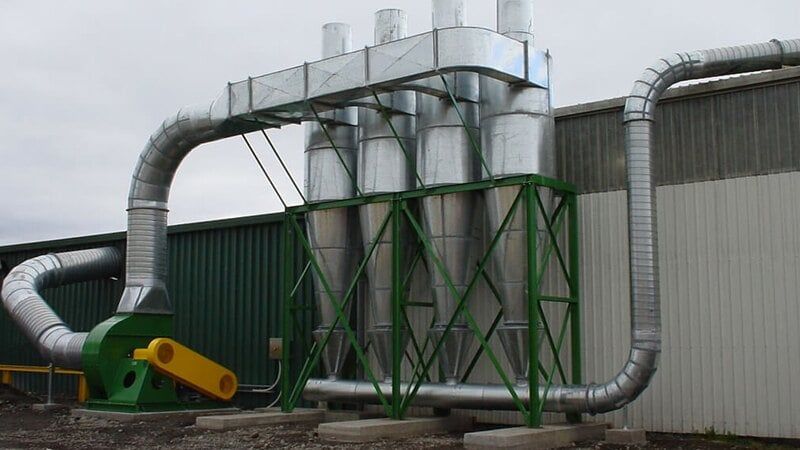
What is a cyclone collector?
A cyclone collector is a mechanical dividing line that uses centrifugal power to remove dust particles from an airflow.
How it works
When the wind enters the cylindrical chamber, it rotates quickly, forcing heavy particles on the outer wall where they enter a gathering container. The clean air comes through the top of the center.
Why it’s effective
This design is simple, but effective, especially for coarse and heavy particles that can prevent traditional filter-based systems.
Benefits of Cyclone Dust Collectors
| Feature | Operational Advantage |
|---|---|
| No Filters Required | Reduces maintenance, downtime, and operating cost |
| Durable for Harsh Conditions | Withstands abrasive and high-volume particulate environments |
| Efficient for Large Particles | Handles coarse dust better than fine filters |
| Low Energy Consumption | Minimal power needed compared to multi-stage filtration |
| Easy to Install and Maintain | Simple structure allows for fast deployment and cleaning |
Common Applications by Industry
| Industry | Typical Use |
|---|---|
| Woodworking | Sawdust and chip collection from sanding and cutting stations |
| Cement and Concrete | Removal of heavy particulate from mixers and grinders |
| Grain Processing | Dust extraction from conveyors and silos |
| Metalworking | Collection of grinding and welding debris |
| Mining | Dust control from drilling and crushing activities |
| Textiles | Fiber particle removal in cutting and processing areas |
Types of Cyclone Dust Collectors
Cyclone collectors type
1. Simple cyclone units
Compact models suitable for small workshops or environment with little mouse.
2. Multi-Sylone system
Use several small cyclones in parallel to treat high airflow; Common in mass industrial setup.
3. Cyclone with high efficiency
Specific designs that improve fine dust separation are often used in combination with secondary filters.
4. Reverse flow cyclone
These use better particles of drop-out and reverse air flow patterns for minimal reintroduction.
2025 Trends in cyclone collection technology
IoT competition monitoring: Dust collectors now come with sensor systems for real-time performance tracking and garbage levels.
-
Environment skilled engines and fans: Energy-saving components reduce the carbon footprint and power bills in the system.
-
Modular design for easy expansion: Companies can add modules as an increase in the creation of dust, which can reduce the requirements in advance.
-
Hybrid configuration: Cyclone pairs with fine particle-shaped filters for complete dust control in sensitive applications.
How to choose the right cyclone collector
Use this checklist before choosing your system:
-
What type of dust (size, weight, abrasive) do you collect?
-
What is the need for your air volume (CFM)?
-
Is this part of a standalone application or a large system?
-
Does your convenience require laptop or fixed installation?
-
Are there limitations in place or ceiling height?
-
Is little maintenance a priority?
-
Are you going to integrate with a secondary filter or scrubbing?
Best practice for installation and maintenance
-
Proper channel design improves psychlony performance – where possible use smooth, right runs.
-
Tom collection jumps regularly to prevent dust construction and pressure loss.
-
Inspection for wear and corrosion, especially high pressure: in tire applications.
-
Provide proper air flow by checking fan speed and inlet design.
-
Add security guards or UV-assessed conservation to the visual areas of the operation.
Case study from the real world: dust control in a cement plant
A cement manufacturer was upgraded to a multi-cyclone system to handle finely powder generated under the mixture. The results include:
-
65% reduction in air dust
-
30% improvement in baghouse lifetime
-
Cleaner work environment and better adherence of regulator
This change enabled the plant to increase production without more than the environmental vessels.
FAQS: Cyclone Dust Collection explained
Question: Have cyclone collectors removed all types of dust?
A: They are the most effective for large, heavy dust particles. For very good or dangerous dust, a secondary filtration system is recommended.
Question: How much space do they need?
A: It depends on the needs of the airflow, but compact models are available for workshops, while industrial versions may require vertical withdrawal.
Question: Are cyclone collectors noisy?
A: Modern design with skilled fans and muffler provides relatively cool operation.
Question: Can I knock down a cyclone collector in my current system?
A: Yes. Cyclon is modular and is often added as a pre-filter to protect downstream filters or fans.
Conclusions: Cleaner operations start with smart dust collection
Cyclone collectors provide a reliable, small maintenance solution for industries that manage high versions of particulate matter. Whether you conduct a wooden shop or mining system, these systems protect air quality, equipment expands life and helps meet environmental standards.
As the innovation continues, the modern cyclone system becomes more smart, more efficient and easy to integrate. For companies, for the purpose of creating a cleaner, safe and more durable work area, investing in cyclone vacuum collection is a practical step.